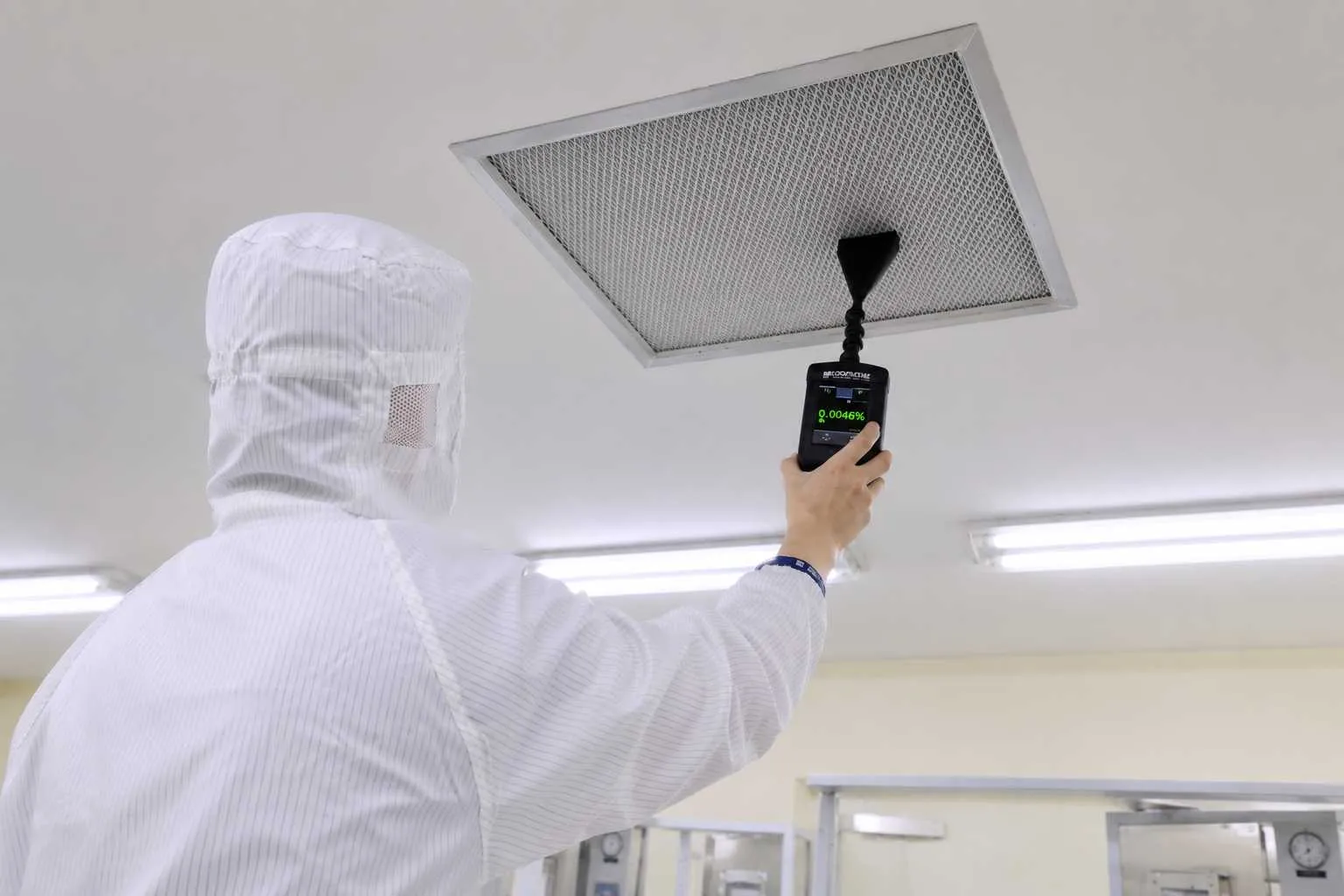
In clean room systems that meet GMP standards (Pharmaceuticals, Electronics, Food, Healthcare), HEPA filters act as "lungs" that directly determine the cleanliness level of the environment. However, no matter how good a HEPA filter is, it can leak due to transportation, installation, or deterioration in lifespan. The appearance of even a small hole the size of a hair is enough to break all clean room standards, causing heavy damage to the product.
That's the reason for the process Leakage Test by DOP Test or PAO Test method is mandatory. The article below by Viet Air Filter (VAF) engineers will provide detailed instructions on this process.
1. What is DOP Test and PAO Test for HEPA filter membrane?
The essence of this method is to use a system to create artificial smoke (Aerosol) in front of the filter (Upstream), then use a photometer (Photometer) to check behind the filter (Downstream) to see if any smoke particles can penetrate or not.
- DOP Test: Use solvents Dioctyl Phthalate. This is the first method, creating a very standard mist particle size (about 0.3 microns). However, DOP chemicals are assessed by the Environmental Protection Agency (EPA) as potentially carcinogenic and toxic to operating engineers.
- PAO Test: Use solvents Poly-Alpha-Olefin. This is the perfect replacement method for current DOP. PAO is a safe, non-toxic, non-carcinogenic synthetic oil recommended by the FDA and modern cleanroom standards. (Today, when mentioning DOP Test, engineers implicitly mean that they are using PAO chemicals).
2. When does the factory need to conduct a PAO/DOP leak test?
According to ISO 14644-3 and GMP guidelines, HEPA filter leak testing (integrity testing) should be performed in the following cases:
- New installation: Immediately after installing the HEPA filter into the AHU system, FFU machine, Hepa Box or Passbox.
- Periodic check: Usually every 6 months for high-level clean rooms (Class 100, Class 1000) and every 12 months for lower levels.
- Maintenance and problems: After the system is down for a long time, there is a strong vibration problem, or when the particle measurement results in the clean room show signs of exceeding the allowable level.
3. Necessary equipment for PAO measurement
To carry out this process, the QA/QC technical team needs to be equipped with 2 core equipment:
- Smoke generator (Aerosol Generator): The function of heating and misting PAO solution into particles ranging in size from 0.3 µm with high density into the air stream blowing to the filter membrane.
- Aerosol Photometer: The device is equipped with a probe (Probe) to suck in gas samples and do optical analysis, thereby measuring the concentration of smoke particles passing through the filter membrane with extremely high sensitivity.
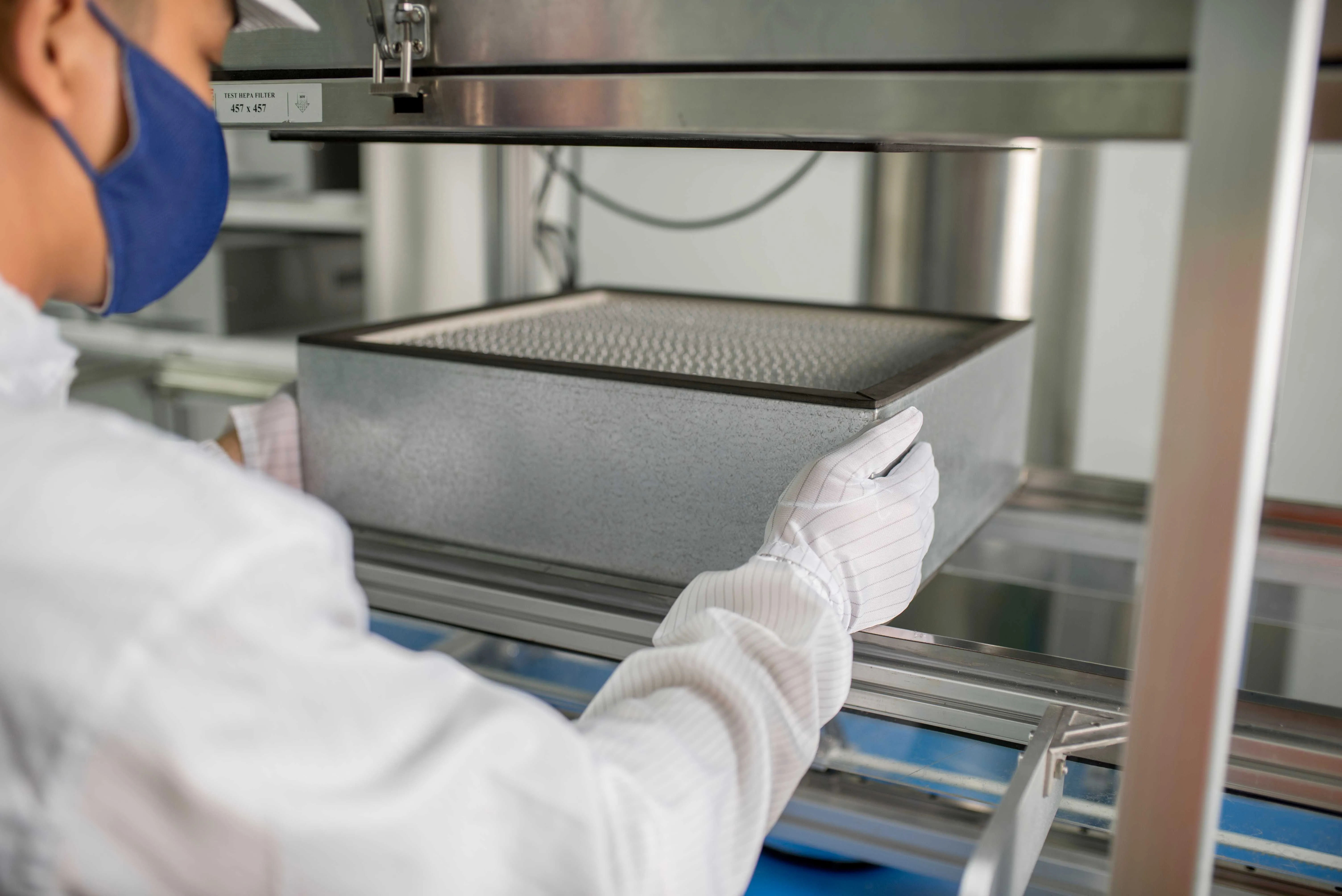
4. Details of the 4-step international standard HEPA filter leak testing process
Step 1: Measure upstream particle concentration (Upstream)
The engineer will inject PAO smoke into the front of the filter (from the AHU air duct or right on the back of the FFU machine). The standard upstream smoke particle concentration needs to reach from 10 mg/m³ to 20 mg/m³ (or 10 µg/L – 100 µg/L). Set this concentration as a 100% reference on the Photometer.
Step 2: Scan the filter surface (Downstream)
The engineer uses the Photometer's probe to scan evenly over the entire protective mesh surface of the HEPA filter. Extremely strict technical requirements:
- Distance from probe to filter surface: About 2.5 cm - 3.0 cm.
- Scanning speed: Slow and steady, Do not exceed 5 cm/sec.
- The scanning lines must overlap each other slightly to ensure that no area is missed.
Step 3: Scan the gasket area and frame
Many leaks do not come from the HEPA filter paper but come from the contact point between the filter frame and the housing, or the rubber gasket (Gasket/Gel seal) is aging and distorted when tightening the screws. Engineers must carefully scan these frame edges.
Step 4: Evaluate results and prepare a report
According to international standards, a HEPA H13/H14 filter is rated as PASS (PASS) when the leakage rate is measured at any point on the surface does not exceed 0.01% (compared to 100% upstream concentration).
5. HEPA VAF filter - 100% PAO tested before leaving the factory
Understanding the rigors of clean room systems, Viet Air Filter (VAF) Proud to be the leading air filtration equipment factory in Vietnam applying international standard quality control procedures.
Unlike floating products of unknown origin, 100% of HEPA (H13, H14) and ULPA filters produced by VAF at the Binh Duong factory are put into an independent test chamber and performed. Scan PAO Test/ DOP Test one by one before packaging.
Products are always fully included when delivered to customers and construction contractors Factory certification (CO, CQ) and Test Report paper clearly state the parameters of differential pressure, air flow and integrity test results (Leak test).
Frequently Asked Questions (FAQ)
Can a punctured HEPA filter be repaired or must it be replaced?
According to IEST-RP-CC034 standard, if the HEPA filter is punctured, you can use specialized silicone glue for clean rooms to patch it. However, the total area of the patches must not exceed 5% total filter surface area, and no patch shall be more than 3.8 cm wide. If this limit is exceeded, it is necessary to replace the filter with a new one to ensure flow and cleanliness.
How often should the HEPA filter be replaced?
The average lifespan of a HEPA filter is 1 - 3 years depending on the environment. Instead of counting time, maintenance engineers will look at the differential pressure gauge (Magnehelic). When the pressure difference passes through the HEPA filter double (or limit) compared to the initial pressure difference when first installed, that is when the filter core is clogged with dust and needs to be replaced immediately.