Selecting an F7, F8 or F9 bag filter for an AHU involves more than matching a class name or frame size. The filter must meet the required supply-air quality while remaining compatible with airflow, pressure drop, available space and fan capability. A class that is too low may miss the air-quality target; a higher class selected without checking resistance may reduce airflow and increase fan energy.
For an introduction to construction and operating principles, read What is a Bag Filter?.
Quick selection: F7, F8 or F9?
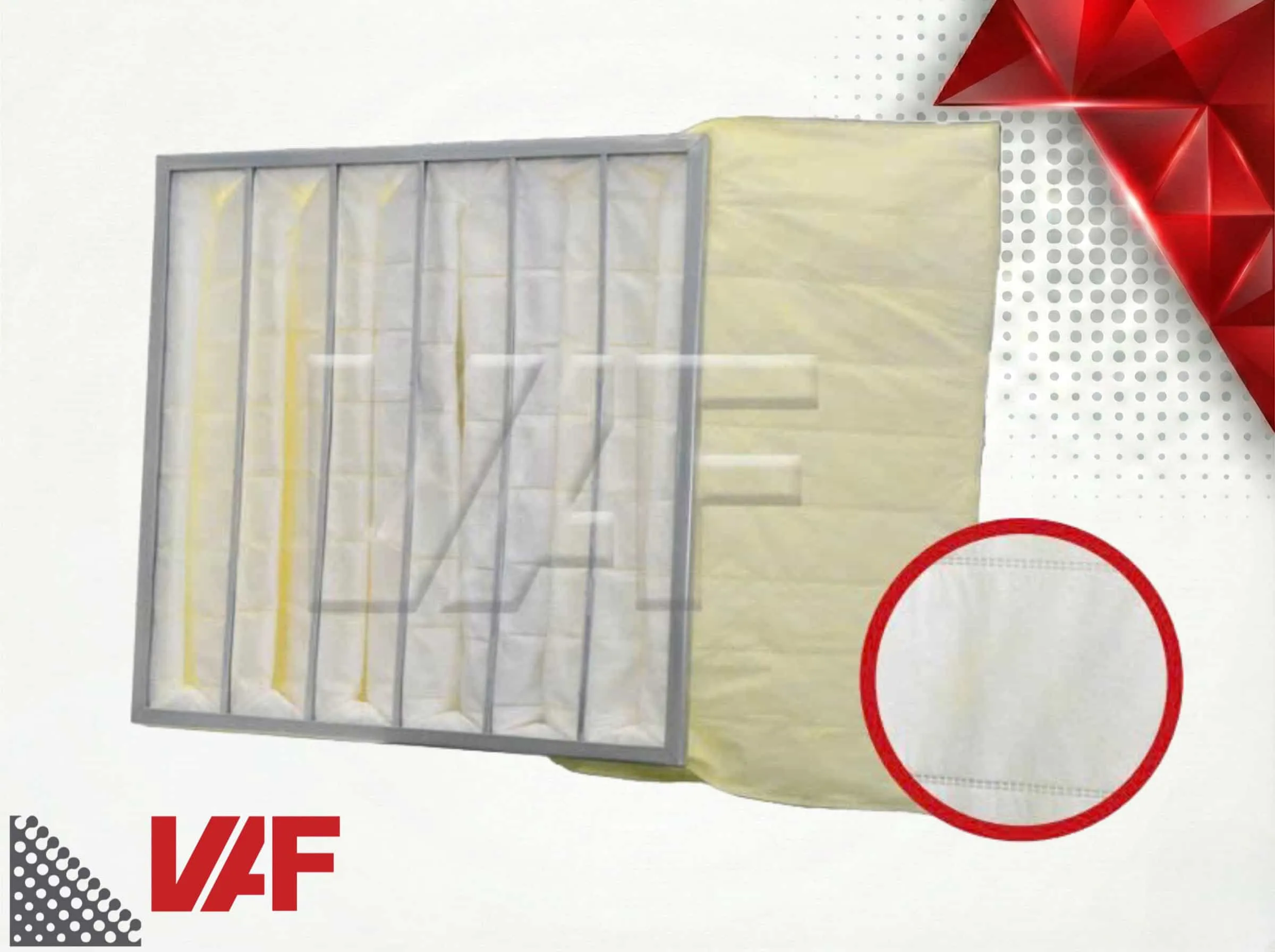
VAF F7, F8 and F9 comparison
In VAF's current V-PAK catalogue, all three ranges use synthetic filter media, offer galvanized steel, aluminium or SS304 frames, and list a maximum operating temperature of 100°C. ISO 16890 values below are the published classifications for these product ranges.
| Criterion | V-PAK F7 | V-PAK F8 | V-PAK F9 |
|---|---|---|---|
| EN 779 name | F7 | F8 | F9 |
| Published ISO 16890 class | ePM1 55% | ePM1 70% | ePM1 80% |
| Pocket count | 3–10 | 3–10 | 3–10 |
| Frame options | GI / Al / SS304 | GI / Al / SS304 | GI / Al / SS304 |
Values may vary with size and configuration. Use the data sheet for the exact item when confirming airflow and pressure drop.
Six parameters to verify before ordering
- Class and standard: state the legacy F class and the required ISO 16890 ePM group where applicable.
- Width × height × depth: measure both the existing filter and the holding frame to prevent bypass or installation problems.
- Rated airflow: compare the flow of the exact size and pocket configuration with the duty of each AHU filter position.
- Initial and final pressure drop: initial resistance affects fan energy; the final limit informs replacement.
- Pocket count and depth: provide enough media area and physical clearance for every pocket to inflate without contact.
- Frame, gasket and environment: select GI, aluminium or SS304 according to humidity, corrosion and hygiene requirements.
Compare total operating cost, not purchase price alone
Fan energy, replacement frequency, downtime and the effect on downstream HEPA filters all contribute to lifecycle cost. Filters with the same class and dimensions can differ in pressure drop and dust-holding behaviour.
Guidance by AHU configuration
Comfort or general industrial AHU
A coarse prefilter followed by F7 can be a starting point, subject to outdoor-air quality, the indoor target and fan capacity.
Higher fine-particle control
Consider F8 or F9 for a higher ePM1 requirement. Check available fan static pressure and measured airflow before upgrading from F7.
AHU with a final HEPA stage
F7–F9 can reduce the dust load on HEPA filters. The appropriate grade depends on incoming dust, cleanliness requirements, energy and the intended maintenance cycle.
Explore all VAF air filters and cleanroom equipment.
Quotation checklist
- Required F class or ePM rating
- Width × height × depth
- Pocket count and quantity
- Airflow per filter or total AHU airflow
- Required pressure drop, if specified
- Frame material and gasket position
- Photo of the existing label
- Installation and environment photos
Frequently asked questions
Should an AHU use an F7, F8 or F9 bag filter?
The selection depends on the required supply-air quality, filter train and fan capability. F7 is often used as a fine filter or HEPA prefilter; F8 and F9 offer higher ePM1 performance but require a model-specific airflow and pressure-drop check.
Are F7, F8 and F9 directly equivalent to ISO ePM1 classes?
No universal direct conversion should be assumed because EN 779 and ISO 16890 use different test methods. VAF publishes its V-PAK F7, F8 and F9 models as ePM1 55%, ePM1 70% and ePM1 80% respectively; verify the data for the exact ordered model.
Is matching the frame size enough when replacing a bag filter?
No. Pocket count and depth, rated airflow, initial and final pressure drop, frame material, gasket location and clearance for full pocket inflation must also be checked.
When should an AHU bag filter be replaced?
Use the final pressure-drop limit specified by the system designer or manufacturer, together with airflow, physical condition and hygiene requirements. Colour or a fixed calendar interval alone is not a reliable rule.
What information does VAF need for a bag-filter quotation?
Provide the required filter class or ePM rating, width × height × depth, pocket count, quantity, airflow when available, frame material, label photos and an installation photo.
Ask VAF to check your bag-filter selection
Send the nameplate or specification list for an F7, F8 or F9 recommendation based on dimensions, airflow, pressure drop and AHU conditions.
VAF hotline: 1900 8949