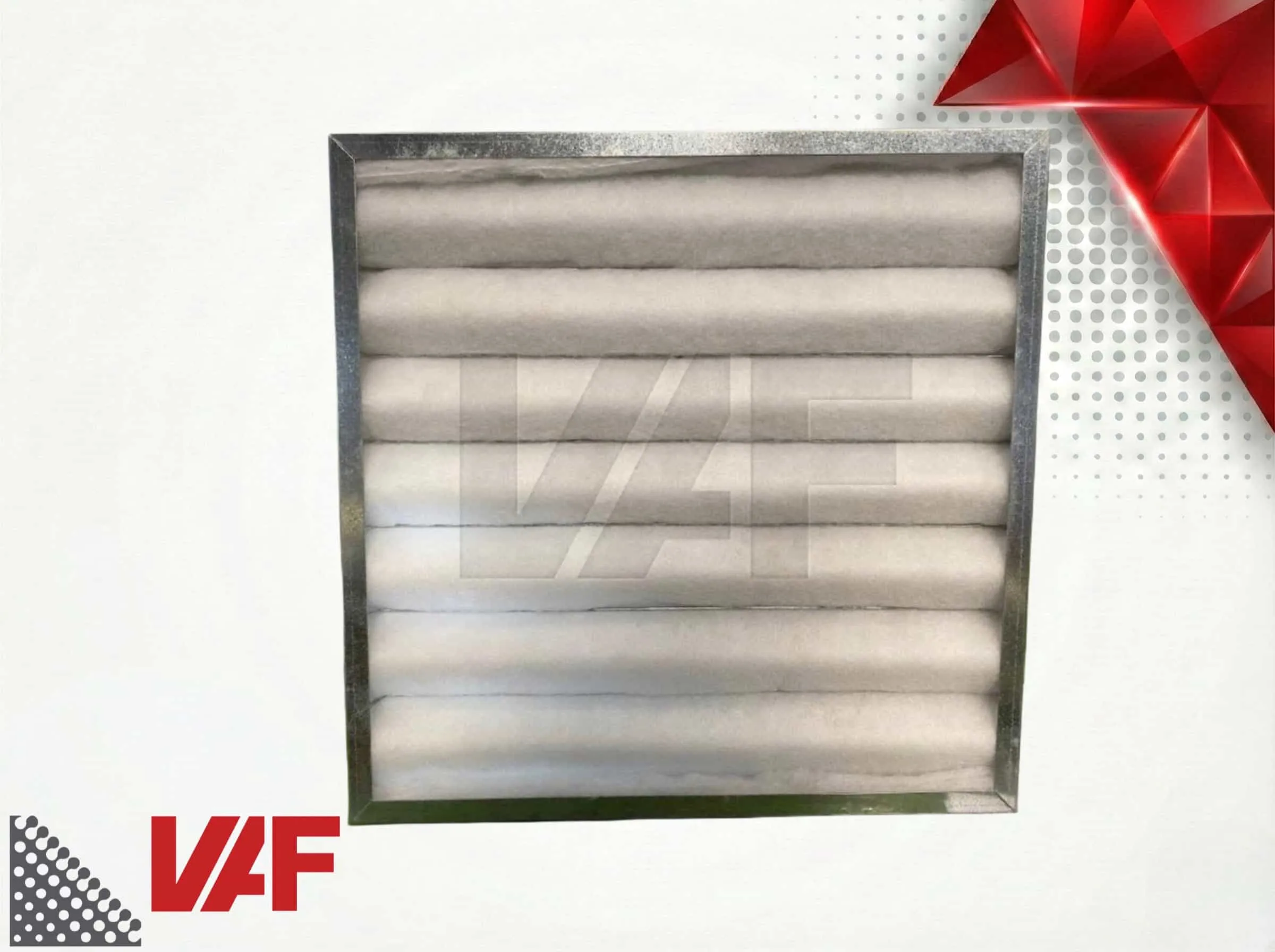
A G4 coarse filter is a familiar prefilter class under EN 779. It is installed at the beginning of an AHU or HVAC filter train to capture larger dust, protect the coil and reduce the load on downstream fine filters. G4 is not HEPA, nor should it be interpreted as a fine-particle efficiency level under ISO 16890. For a replacement, confirm the exact model, dimensions, airflow and pressure drop instead of ordering by the term “G4” alone.
The cover image shows a VAF V-RW pleated panel filter. The supplied filter class and performance data are confirmed for each model, size and technical specification.
1. What is a G4 coarse filter and where is it used?
G4 is a class from the former EN 779 classification system. In day-to-day operation in Vietnam, it still appears on older drawings, filter labels and purchase requests. A G4 filter primarily serves as a prefilter, capturing hair, fibres and a portion of the coarse dust before the air reaches a coil or a higher-efficiency filtration stage.
Common locations include outdoor-air intakes, return-air grilles, AHU inlets, factory HVAC systems and the protective stage ahead of bag filters. The G4 designation describes a filter class under one test method; it does not fully specify dimensions, airflow, frame material, moisture resistance, pressure drop or service life.
Quick answer
If the AHU documentation specifies “G4,” use that as a starting point. Before ordering, check the existing model label or test report, remeasure the frame and confirm the operating conditions. Do not choose a panel solely because it carries the same G4 designation.
2. Are G4 and ISO Coarse the same?
ISO 16890-1 classifies general-ventilation air filters by their efficiency for the ePM1, ePM2.5, ePM10 and ISO Coarse particle groups. This assessment differs from EN 779, so there is no mandatory one-to-one conversion from G4 to a single ISO Coarse percentage for every filter design.
| Common designation | Classification system | What it means when purchasing |
|---|---|---|
| G4 | EN 779 | A familiar coarse-filter class found in older documents and products; data for the exact model are still required. |
| ISO Coarse X% | ISO 16890 | The X% value is the reported synthetic-dust arrestance for the coarse-filter group under the standard's method. |
| ISO ePM10 / ePM2.5 / ePM1 X% | ISO 16890 | States the particle-size group and reported efficiency; it cannot be inferred from the G4 designation alone. |
Some industry comparison tables place G4 near ISO Coarse 60%. This is only a reference point for interpreting older documents, not certification that every G4 filter achieves the same percentage. Eurovent 4/23 likewise explains the differences between the two classification systems and provides ISO 16890 selection guidance.
Update, 17 November 2026: ISO is finalising Edition 2 of Part 1. The ISO 16890-1 Edition 2 project page shows it at the publication stage. In tender or acceptance documents, specify the standard number and applicable edition rather than writing only “according to ISO.”
3. Where a G4 filter fits in an AHU filter train
A filter train may include a prefilter, a fine filter and a HEPA filter, but not every system requires all three stages. The configuration must reflect outdoor-air quality, supply-air requirements, dust load, installation space and fan capacity.
Prefilter
G4 or a suitable ISO Coarse class captures larger dust and protects the coil and fine filter.
Fine filter
Select it for the required ePM efficiency, airflow and pressure drop. See how to select F7, F8 and F9 bag filters.
HEPA
Use it when the application requires a HEPA class and the system is designed accordingly; it is not an automatic upgrade from G4.
A suitable prefilter can reduce the dust reaching more expensive downstream stages, but every stage also increases total resistance. Before adding or upgrading filtration, confirm that the fan can still deliver the design airflow. The Eurovent Certified Performance guidance illustrates why filter data must be read together with airflow, dimensions and pressure drop, not just the filter-class designation.
4. Common G4 coarse-filter formats
| Filter format | Characteristics | What to check | VAF range for reference |
|---|---|---|---|
| Filter-media roll | Cut to size and used with a retaining frame or mesh. | Thickness, media orientation, effective area and retaining arrangement. | V-Roll |
| Flat panel filter | Compact, metal-framed and washable on applicable models. | Overall dimensions, frame material, gasket and cleaning limits. | V-R |
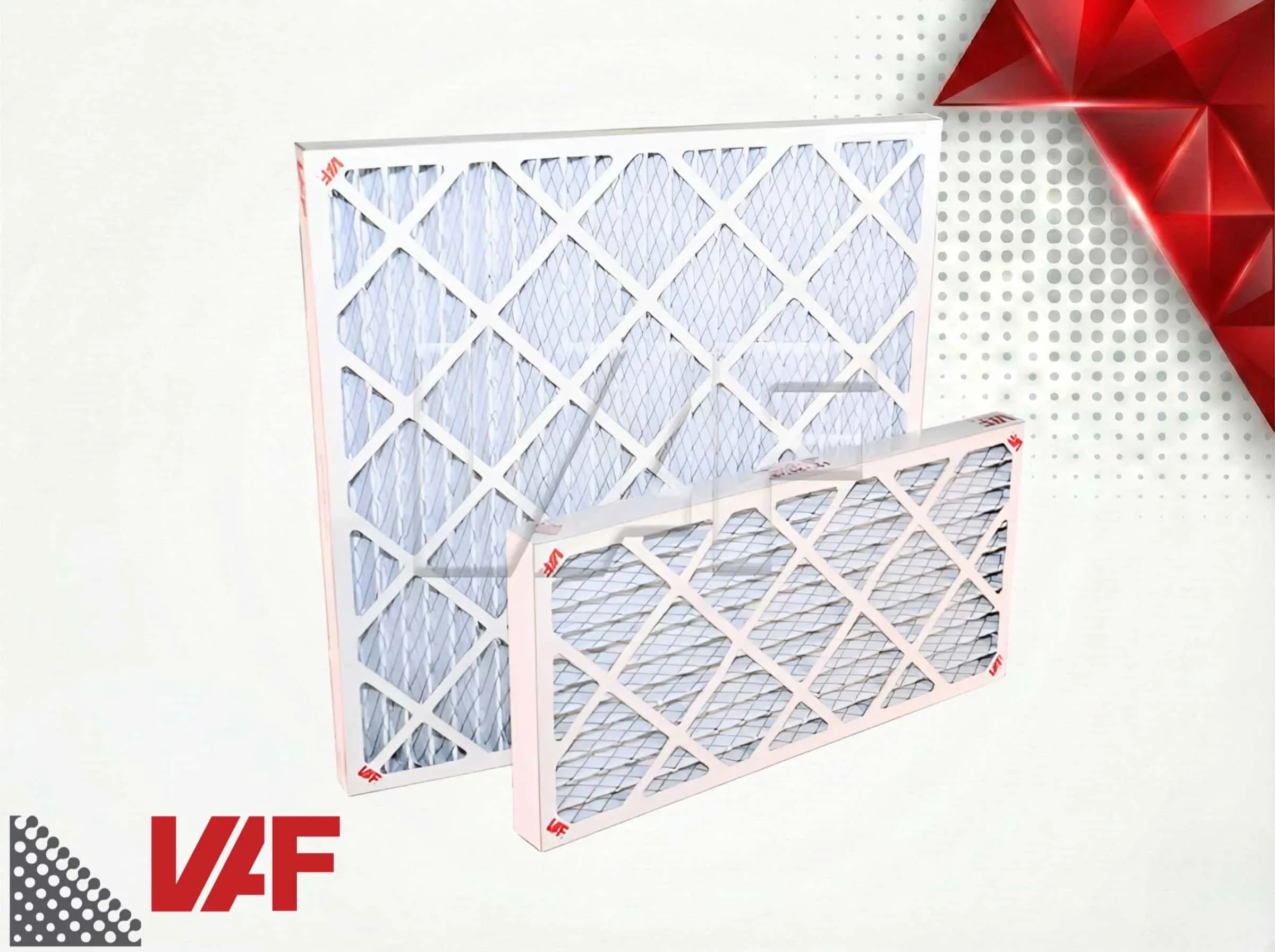
| Pleated panel filter | Provides more media area within the same face dimensions. | Depth, airflow, pressure drop and installation clearance. | V-RW, V-RZ |
| Disposable filter | Quick to replace, with no washing and drying procedure. | Moisture resistance, storage conditions and replacement schedule. | V-DI |
5. Seven items to check when selecting a G4 filter for an AHU
- Overall dimensions: record width × height × depth in millimetres. Measure the frame, not only the media area. See our AHU filter measurement guide.
- Design airflow: filters of the same size but different construction can have different airflow and pressure-drop characteristics. Obtain the value from the AHU documentation or the responsible engineer.
- Face velocity: airflow divided by filter face area. A change in velocity changes resistance and may affect efficiency.
- Initial pressure drop: compare values at the same airflow or velocity. A pressure value in pascals without its test condition is insufficient for comparing two models.
- Final pressure drop: use the model and system limits to set a replacement alarm; do not apply one value to every AHU.
- Frame, gasket and airflow direction: confirm the frame material, number of gasketed faces, clamping arrangement and installation direction to prevent edge bypass.
- Operating conditions: temperature, humidity, dust load, grease or chemicals may determine the appropriate materials and maintenance interval.
Example: reading data for the exact model
In the VAF product table, one V-RW 92 size of 592 × 592 × 46 mm is rated at 3,400 m³/h, with an initial pressure drop of 85 Pa and a recommended final pressure drop of 250 Pa. These figures apply to the stated size and published conditions; they are not default values for every G4 filter.
View V-RW data by size6. Quick selection guidance by requirement
Replacing the existing AHU filter like for like
Photograph the label, remeasure the frame, record the airflow direction and verify the airflow. If the existing model is no longer available, ask the supplier to state the technical basis for the replacement selection rather than merely confirming “same G4 class.”
Extending bag-filter or HEPA-filter service life
Assess the incoming dust load and available prefilter space. Check the clean pressure drop of the complete filter train and the fan capacity before adding another stage.
Humid conditions or periodic cleaning
Select a suitable frame and media, and request the cleaning instructions for the exact model. “Washable” does not mean that efficiency and durability remain unchanged after an unlimited number of wash cycles.
Ordering custom sizes in quantity
Send a schedule listing each size, quantity, frame material and delivery condition. Do not combine similar dimensions into one line when the installation openings differ.
7. Monitoring pressure drop and determining when to replace the filter
Visible dirt is not the only indicator. Monitor pressure drop across the filter under stable operating conditions, check airflow and physical condition, and compare the result with the model or system limit. Replace the filter when it reaches the approved limit, when it is damaged, damp, mouldy or torn, or when the facility's hygiene requirements call for replacement.
If the filter loads unusually quickly, investigate causes such as an outdoor-air intake near a dust source, bypass gaps, incorrect face velocity or the area's cleaning schedule. Simply shortening the replacement interval without addressing the cause may allow costs to keep rising. Read more about signs and principles for air-filter replacement.
8. Checklist for a G4 filter quotation
- Company name, contact person and delivery location.
- Filter format: media roll, flat panel, pleated panel or disposable filter.
- Required class on the drawing and applicable standard; include the test report if a comparison is required.
- Width × height × depth and quantity for each size.
- AHU airflow, face velocity or equipment identifier, if available.
- Initial pressure drop and approved final limit.
- Frame material, gasket, airflow direction, temperature and humidity.
- Photos of the label, front, side and filter opening.
Send your specifications for a configuration review
VAF advises on and manufactures coarse, fine and HEPA filters in custom sizes for AHUs, HVAC systems and cleanrooms. Send photographs and a filter schedule so our technical team can review the requirements before preparing a quotation.
9. Frequently asked questions about G4 coarse filters
What is a G4 coarse filter?
G4 is a familiar coarse-filter class under EN 779, commonly used as a prefilter to capture larger dust and protect coils and downstream fine filters. For a new purchase, also request the ISO 16890 classification or test report for the exact model.
What ISO Coarse percentage is equivalent to G4?
There is no mandatory conversion value that applies to every filter. Some industry reference tables place G4 near ISO Coarse 60%, but the result must be confirmed by ISO 16890 data for the exact model at the applicable test airflow.
Can a G4 filter remove fine PM2.5 particles?
G4 is primarily a coarse prefilter class, and the G4 designation should not be used to infer PM2.5 efficiency. If fine particles are the target, select the appropriate ISO ePM class and check the complete filter train and fan capacity.
Should a G4 filter be installed before a bag filter or HEPA filter?
A suitable prefilter can reduce the dust load on coils, bag filters and HEPA filters, but the configuration must follow the AHU design, incoming-air quality, airflow and allowable pressure drop.
What information is needed for a G4 filter quotation?
Send photos of the filter and existing label, width × height × depth, quantity, frame and gasket details, airflow or AHU identifier, available pressure-drop data, temperature and humidity conditions, and the delivery location.